Raumsonde Logo

Simplifying access to open space

Raumsonde connects the layers that keep creative communities from using the spaces they need - making spatial, regulatory, and administrative processes navigable for the first time.

Explore how
Our Vision

We remove the barriers between ideas and open space.

Creative initiatives should not need a legal team to access a park, a courtyard, or a vacant lot. Raumsonde maps the complexity between a spatial vision and its realisation - and turns it into a path anyone can walk.

The Structure

The path to open space crosses four layers that do not talk to each other.

Every creative use of urban and open space requires navigating spatial data, land-use frameworks, regulatory conditions, and administrative procedures. These layers exist in silos. Without a guide, the cost of connecting them falls entirely on the person with the idea.

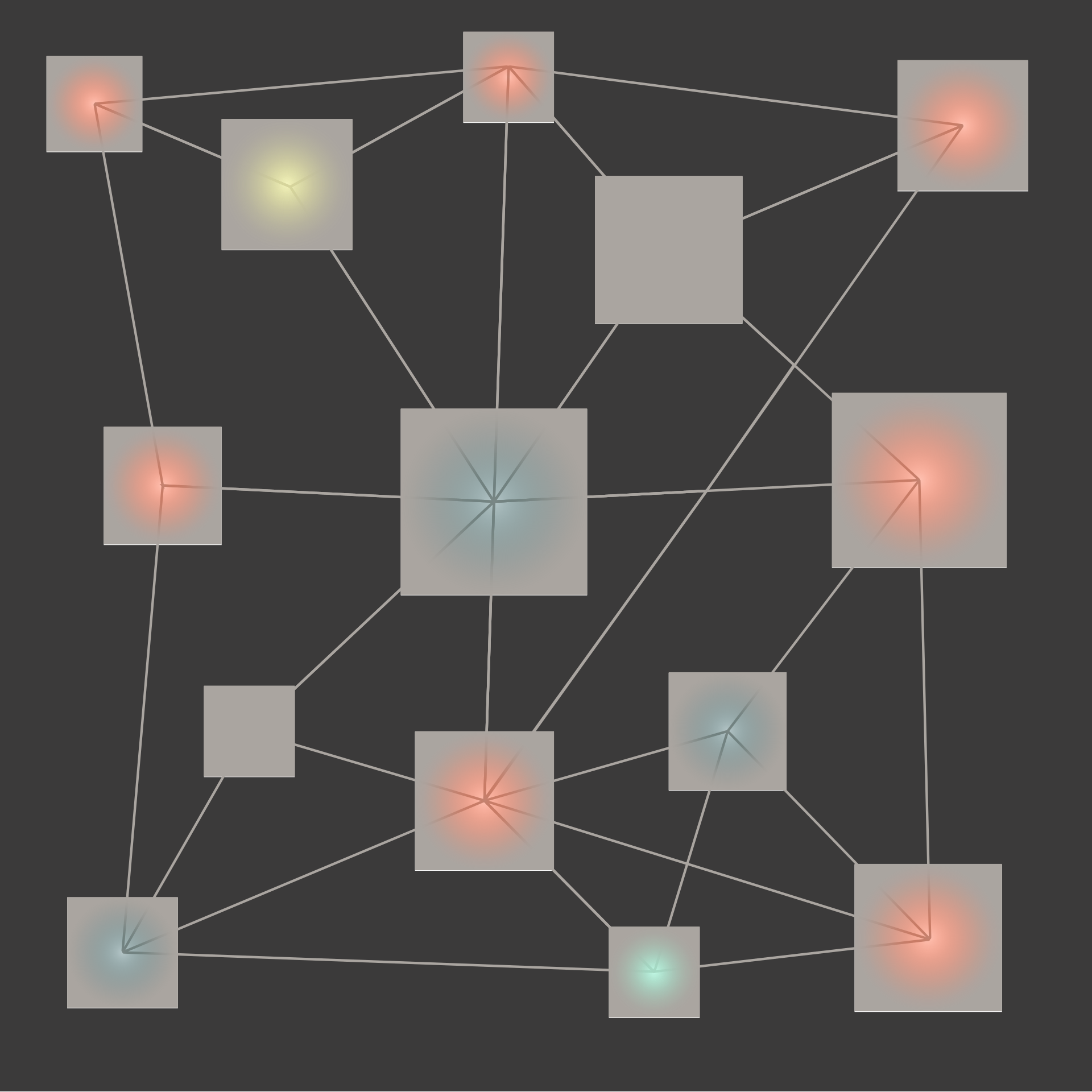
The path from spatial vision to realisation crosses layers that were not designed to connect.

Every creative initiative must navigate four separate governance layers - alone, without a map, and without a guide.

Spatial data, land-use designation, regulatory conditions, and administrative procedure are managed by different institutions and encoded in different systems. Connecting them requires knowledge that is rarely documented and time that most initiatives cannot afford.
1

Creative Vision for Space

Where the idea lives. A spatial vision carries requirements - scale, duration, infrastructure, noise - that must be translated into the institutional language of each layer above it. Without that translation, the idea cannot move forward.

2

Land-Use

Every space has a legal designation: public street, green area, protected zone, or privately-owned land. These designations determine what is possible - and who has the authority to grant it.

3

Regulations

Conditions of use - noise thresholds, safety requirements, environmental protections, event ordinances - are encoded in legislation that varies by space type, activity, and administrative district. These conditions are enforceable and consequential, but seldom consolidated in one place.

4

Administrative Processes

Permit processes are distributed across multiple public authorities, each with its own jurisdiction, timeline, form logic, and expectations. Applications that do not anticipate these requirements correctly are delayed, returned, or rejected - placing the burden of institutional knowledge on the applicant.

Our Methodology

We connect the layers into a single navigable workflow.

Raumsonde's methodology maps the relationships between creative intent, spatial designation, regulatory conditions, and administrative requirements - and encodes them into a guided, context-specific process. The output is not just accessible to users. It is structured to meet the expectations of the institutions on the other side.

One method, adapted to each context.

One methodology. Deployable across contexts.

The structural logic that connects Berlin's event permitting landscape applies wherever creative communities encounter complex spatial governance. The methodology adapts to local regulatory frameworks, land-use systems, and administrative structures - while the underlying approach remains consistent.

Simple Access

Raumsonde Berlin: a working model for civic access to Public Space.

Berlin's event permitting landscape was not built for the people who make up most of the city's cultural life. Spatial data, permit requirements, and application procedures vary across districts, space types, and event categories - and the full cost of navigating this falls on small-scale, non-commercial organisers.

Raumsonde Berlin connects all four governance layers into one platform. In its 2024 independent evaluation, researchers at Humboldt University Berlin described it as a "democracy tool" - generating new possibility space between civil society and public administration.

Cooperation

Help us improve the accessibility to space

The challenge Raumsonde addresses in Berlin is not unique to Berlin. Wherever spatial governance is fragmented, creative and civic access to open space is structurally constrained. We work with city administrations, cultural organisations, and operators of open and semi-public spaces to build context-specific solutions on this methodology.

How we work with you

Map your context

1

We begin by mapping the spatial, regulatory, and administrative landscape of your context - identifying the layers, their relationships, and the specific points where access breaks down for the people who need it.

Define the use case

2

Together we scope the application: event permitting, community space access, temporary use activation, or another entry point. The use case determines which parts of the methodology to build first and what a successful outcome looks like for both users and institutions.

Build the solution

3

We integrate your spatial data, regulatory conditions, and administrative requirements into the Raumsonde framework. The result is a context-specific tool that guides users through the process - and delivers outputs that meet institutional requirements from day one.

Deploy and iterate

4

Your internal workflows remain intact. Raumsonde manages the complexity at the point of access. As the tool is used, it surfaces insights about where friction persists - providing a basis for improving both the platform and, over time, the underlying processes it reflects.

Get in touch with us